

A cosmic journey in pixels
Welcome to my astrophotography gallery, where I share my passion for capturing the breathtaking beauty of the cosmos. Each image is a window into the wonders beyond our world, inviting you to explore the universe through my lens.
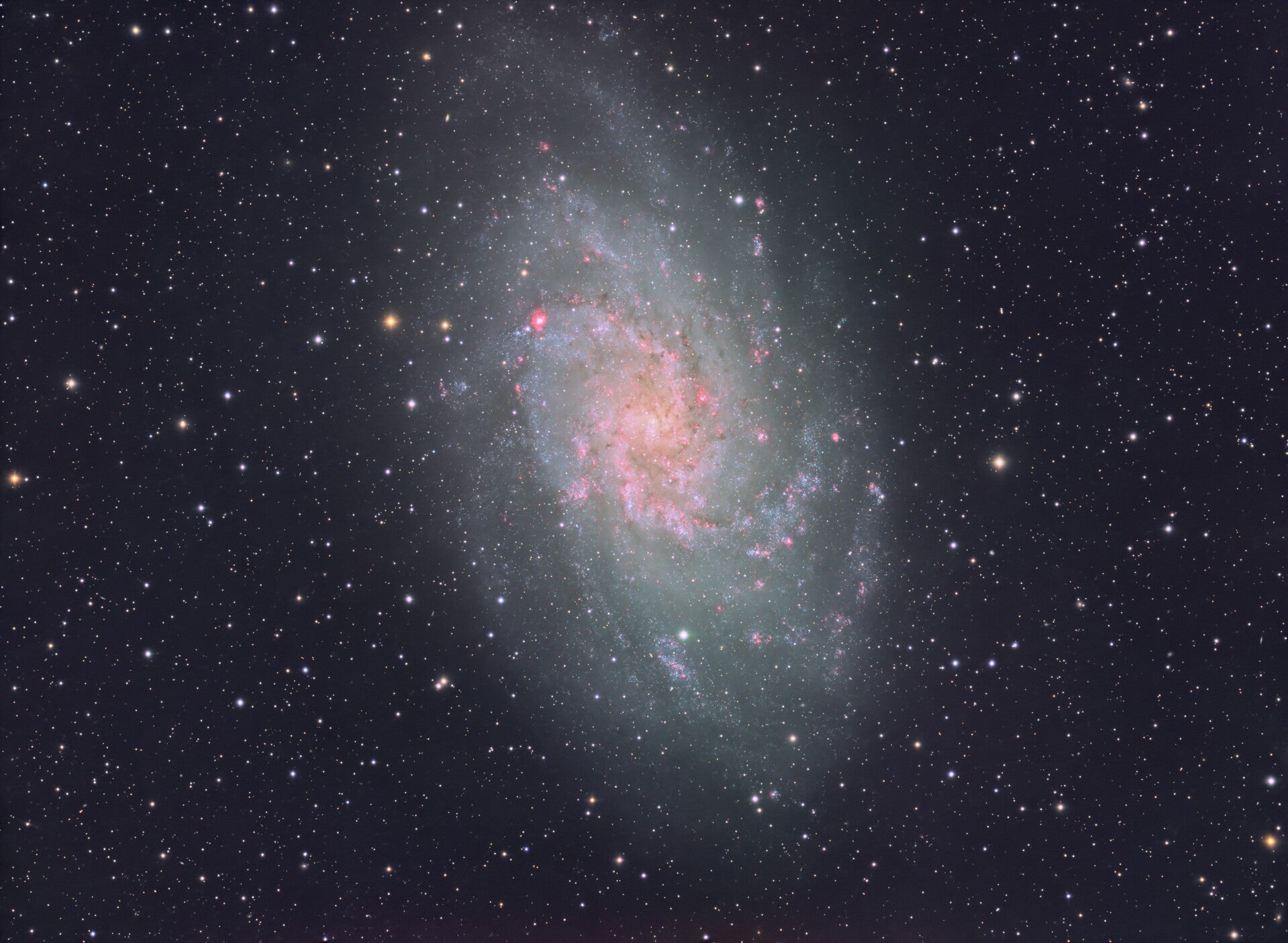
Galaxies: millions of light-years away
It's always incredibly rewarding to capture the intricate details of galaxies, especially when you consider they are millions of light-years away.
The Triangulum Galaxy (M33)
The Triangulum Galaxy, also known as Messier 33 or NGC 598, is a spiral galaxy located approximately 3 million light-years from Earth in the constellation Triangulum. It is the third-largest member of the Local Group of galaxies, after the Andromeda Galaxy and our own Milky Way. M33 is notable for its abundant star-forming regions, particularly its numerous bright nebulae and young, massive stars. It is a popular target for amateur astronomers due to its relatively large apparent size and brightness, making it visible with binoculars under dark skies. While it is not as grand as Andromeda, M33 offers a captivating view into the dynamic processes of galactic evolution and star birth.
Nebulae: stellar nurseries of the universe
Explore the stunning beauty of nebulae, the celestial clouds where stars are born and die. Their vibrant colours and ethereal forms are a testament to the dynamic processes occurring across the cosmos.
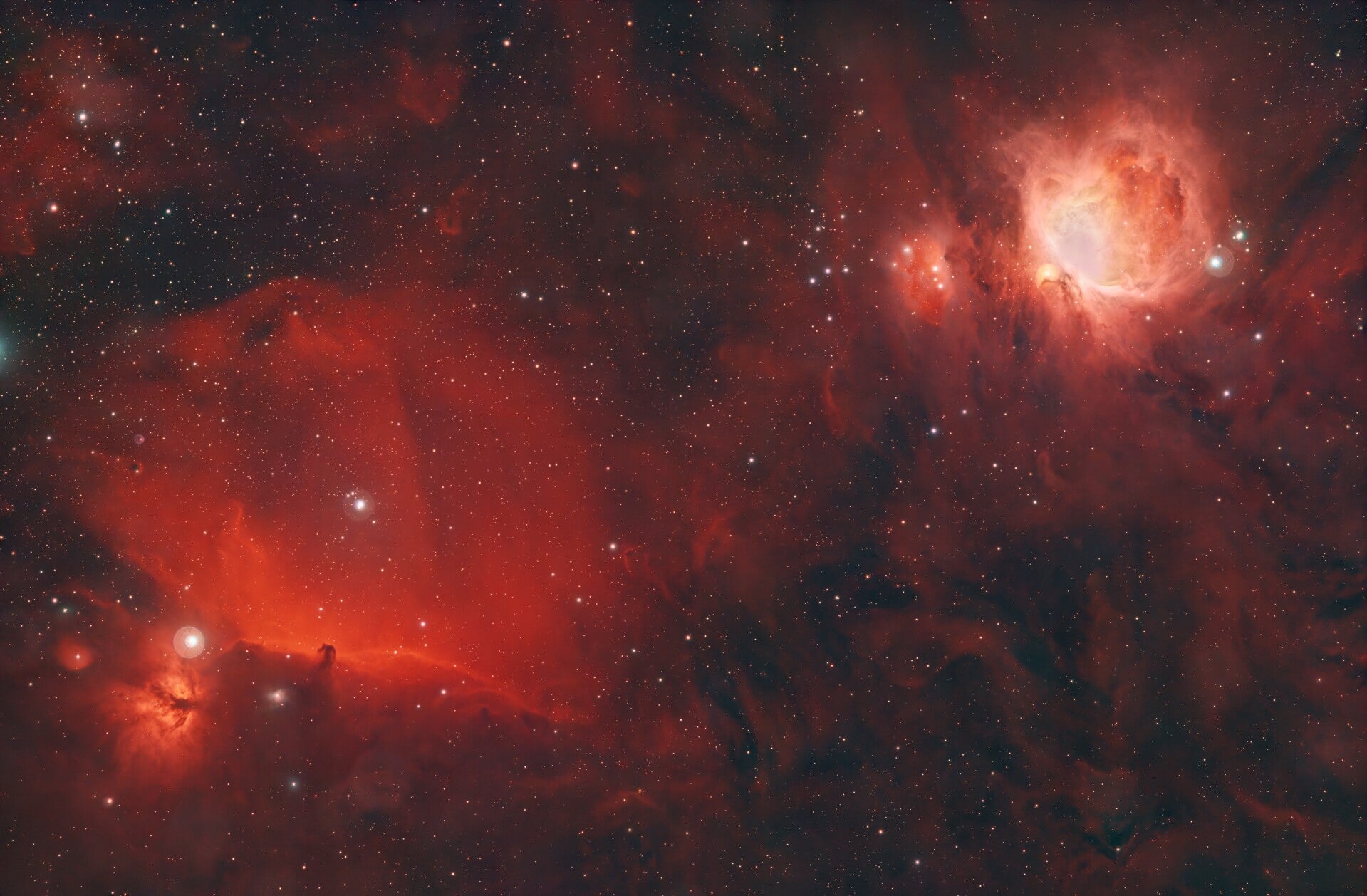
Cosmic Red: Hydrogen Gas Between Nebulae
The vast expanse between the Flame and Horsehead Nebulae and the Orion Nebula (M42) is not an empty void, but rather a region permeated by diffuse hydrogen gas. This hydrogen, primarily in its atomic or molecular form, glows with a characteristic red hue when energised by the intense ultraviolet radiation from nearby hot, young stars. This emission, known as H-alpha, is a key indicator of star-forming regions and the presence of ionised hydrogen, painting a vibrant crimson backdrop across these iconic celestial landscapes and revealing the intricate interplay of gas, dust, and stellar activity that shapes our galaxy.
Star clusters and widefield views
From dense star clusters twinkling like diamonds to sweeping widefield views of the Milky Way, these images aim to convey the immense scale and breathtaking beauty of our universe. Each capture is an invitation to appreciate the vastness around us.
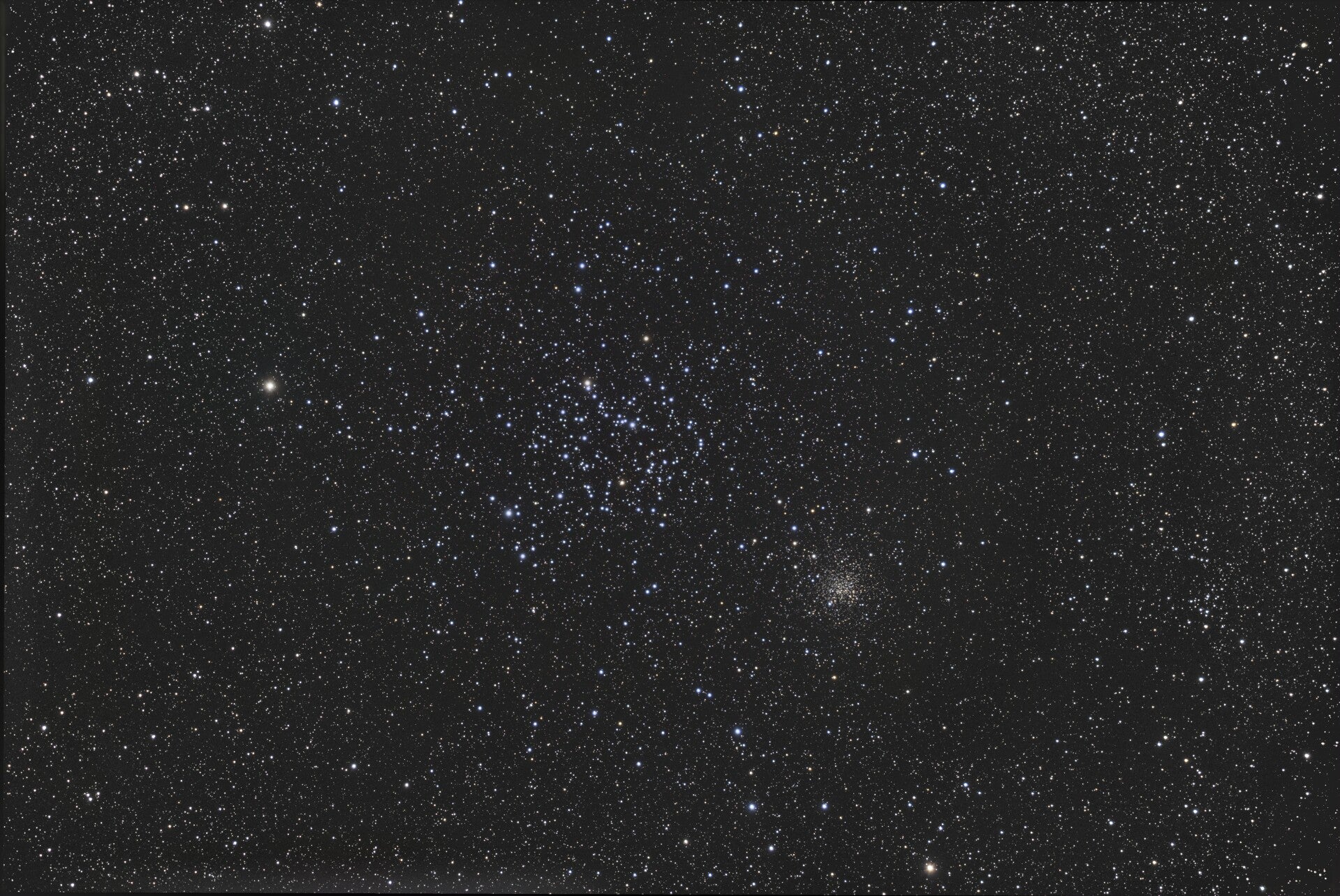
M35 and NGC 2158: A Tale of Two Star Clusters
M35 and NGC 2158 are two open star clusters located in the constellation Gemini, offering a fascinating contrast in stellar evolution. M35, also known as NGC 2168, is a relatively young and close cluster, estimated to be around 100 million years old. Its stars are predominantly hot, blue, and bright, indicative of their youth and high mass. In stark contrast, NGC 2158, situated further away and appearing much smaller in the sky, is significantly older, with an estimated age of over 1 billion years. This age difference is clearly reflected in its stellar population; NGC 2158 is rich in older, cooler, and more evolved stars, giving it a distinct yellowish-orange hue compared to the brilliant blue of M35. Observing these two clusters together provides a striking visual demonstration of how star colours change as they age, with younger clusters dominated by blue giants and older clusters showcasing a prevalence of redder, more evolved stars.
Create Your Own Website With Webador