

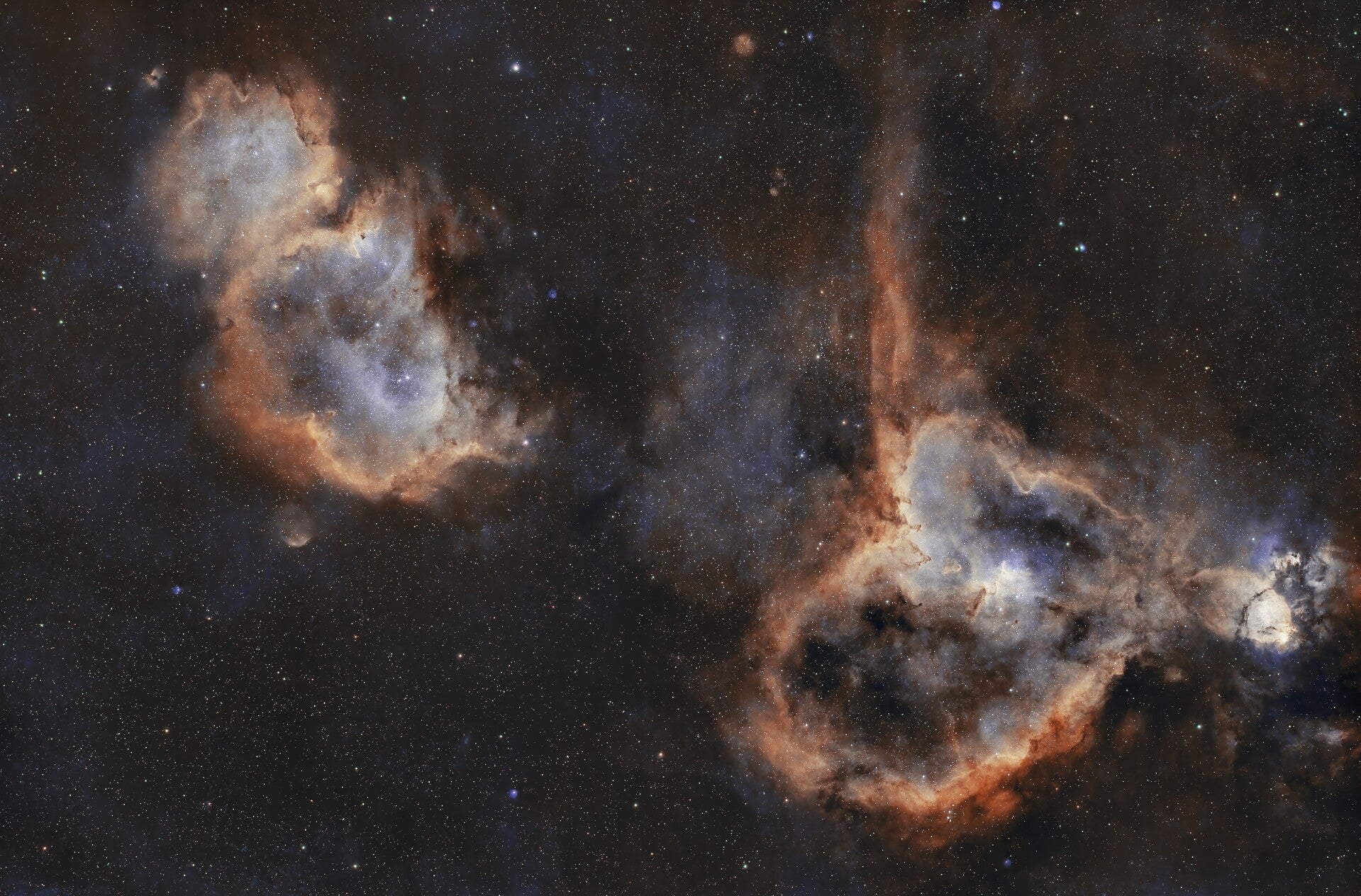
Heart and Soul Nebulae: A Detailed Glimpse
The Heart and Soul Nebulae, officially designated IC 1805 and IC 1848 respectively, are two magnificent emission nebulae located in the Perseus Arm of our Milky Way galaxy, approximately 7,500 light-years from Earth. These vast cosmic clouds of gas and dust are active star-forming regions, glowing brightly due to the ionisation of hydrogen gas by the intense ultraviolet radiation from massive, hot, young stars within them. The Heart Nebula, with its distinctive heart-like shape, is home to the open cluster Melotte 15, whose energetic stars are largely responsible for illuminating the nebula. The Soul Nebula, often appearing as a more diffuse and sprawling structure, also contains several small open clusters and dark nebulae, hinting at ongoing stellar birth and evolution.
This image was processed in PixInsight using the HOO palette to highlight their intricate structures. Despite the diminutive scale achieved with a Takahashi FS-60 CB telescope, an ASI 071 MC Pro camera, and an L-Enhance filter, the resulting detail is remarkably clear. The image is a testament to the effectiveness of two hours of unguided 2-minute sub-exposures, revealing the subtle nuances within these celestial wonders.
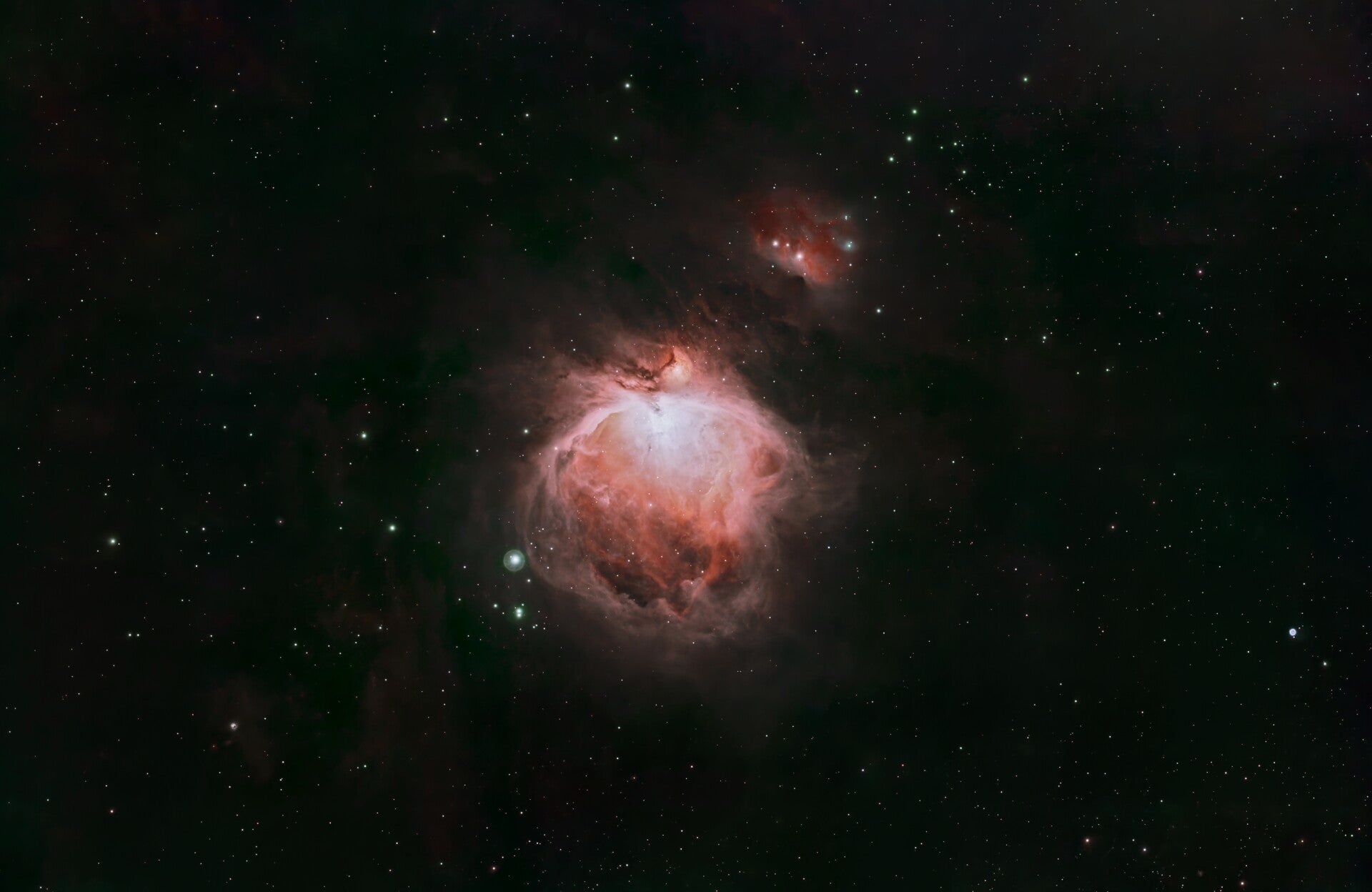
Orion Nebula Under Full Moon: A Detailed Glimpse
The Orion Nebula (M42) is a magnificent stellar nursery, a vast cloud of gas and dust where new stars are being born. Its intricate structures and vibrant colours make it a perennial favourite for astrophotographers. However, capturing its beauty, especially from light-polluted areas or during a full moon, can be a significant challenge. The bright lunar glow washes out fainter nebular details, making it difficult to achieve a high signal-to-noise ratio in your images.
This is where narrowband filters, such as the Optolong L-Extreme, prove invaluable. The L-Extreme is a dual-bandpass filter designed to isolate the H-alpha and OIII emission lines, which are prominent in many nebulae, including the Orion Nebula. By selectively allowing only these specific wavelengths of light to pass through to your camera sensor, the filter effectively blocks out a significant portion of light pollution and, crucially, the broad-spectrum light emitted by the moon.
Even under the glare of a full moon, the Optolong L-Extreme can dramatically improve your imaging results. The filter's narrow bandpasses mean that the moonlight, which is essentially reflected sunlight, is largely rejected. This allows the faint emission from the nebula to stand out against a much darker background, even when the sky is visibly bright. While the moon's presence will still contribute some sky glow, the L-Extreme's ability to isolate the nebular emissions means you can achieve surprisingly detailed and vibrant images of the Orion Nebula that would otherwise be impossible without such a filter. This makes it a powerful tool for astrophotographers seeking to maximise their imaging opportunities, regardless of lunar phase or light pollution levels.
This image was captured with a Takahashi FS-60 CB telescope and an ASI 071 MC Pro camera with a total of one hour of unguided two-minute sub-exposures.
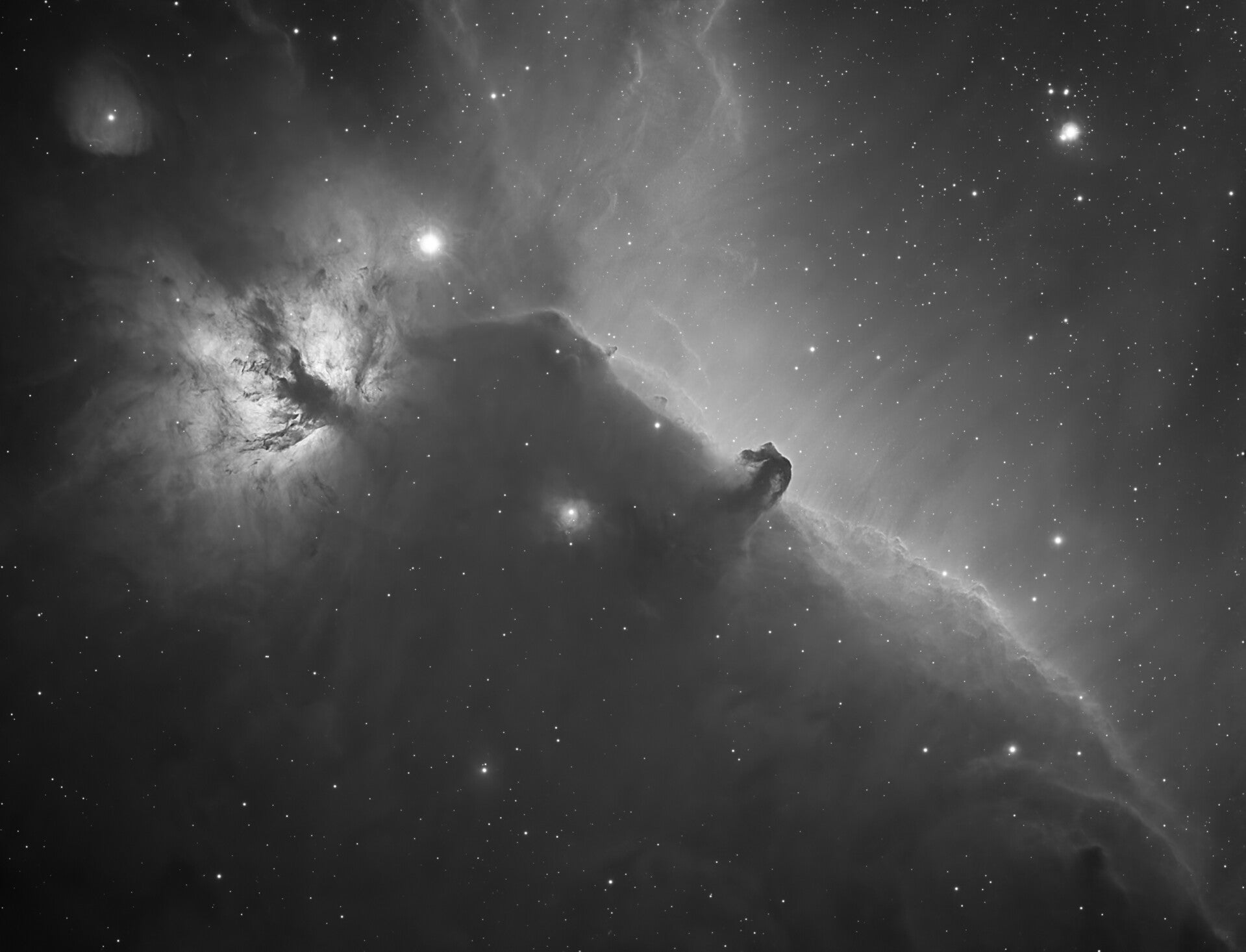
The Horsehead and Flame Nebula
This striking image, captured several years ago, showcases the iconic Horsehead and Flame Nebulae in the constellation Orion. The photograph was taken using the FS-102 telescope, an SBIG ST-8300 CCD camera, and a 12nm hydrogen alpha filter. This specific setup allowed for the detailed capture of the nebulae's intricate structures, highlighting the glowing hydrogen gas that defines these celestial wonders.
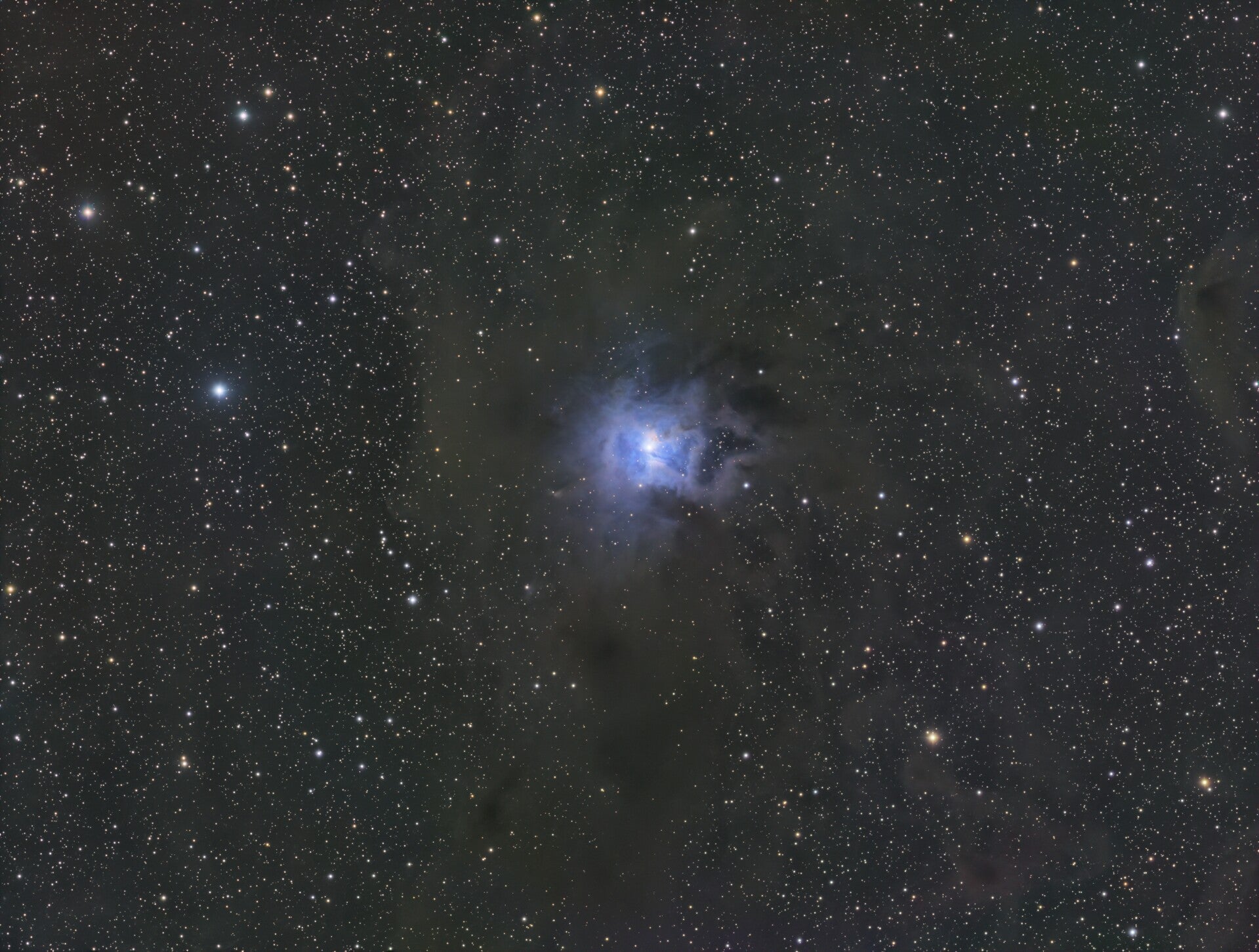
The Iris Nebula: A Celestial Flower
The Iris Nebula, also known as NGC 7023, is a beautiful reflection nebula located in the constellation Cepheus. This cosmic cloud of dust and gas gets its name from its resemblance to an iris flower. The nebula is illuminated by a hot, young star, SAO 19158, which is embedded within its dusty folds. The blue colour of the nebula is due to the scattering of light from this star by tiny dust particles, a process similar to why Earth's sky appears blue.
This particular image of the Iris Nebula was captured using an FS-102 telescope, paired with an SBIG ST-8300 camera. The image was taken through LRGB filters, which allowed for the capture of detailed colour information, enhancing the nebula's intricate structure and vibrant hues.
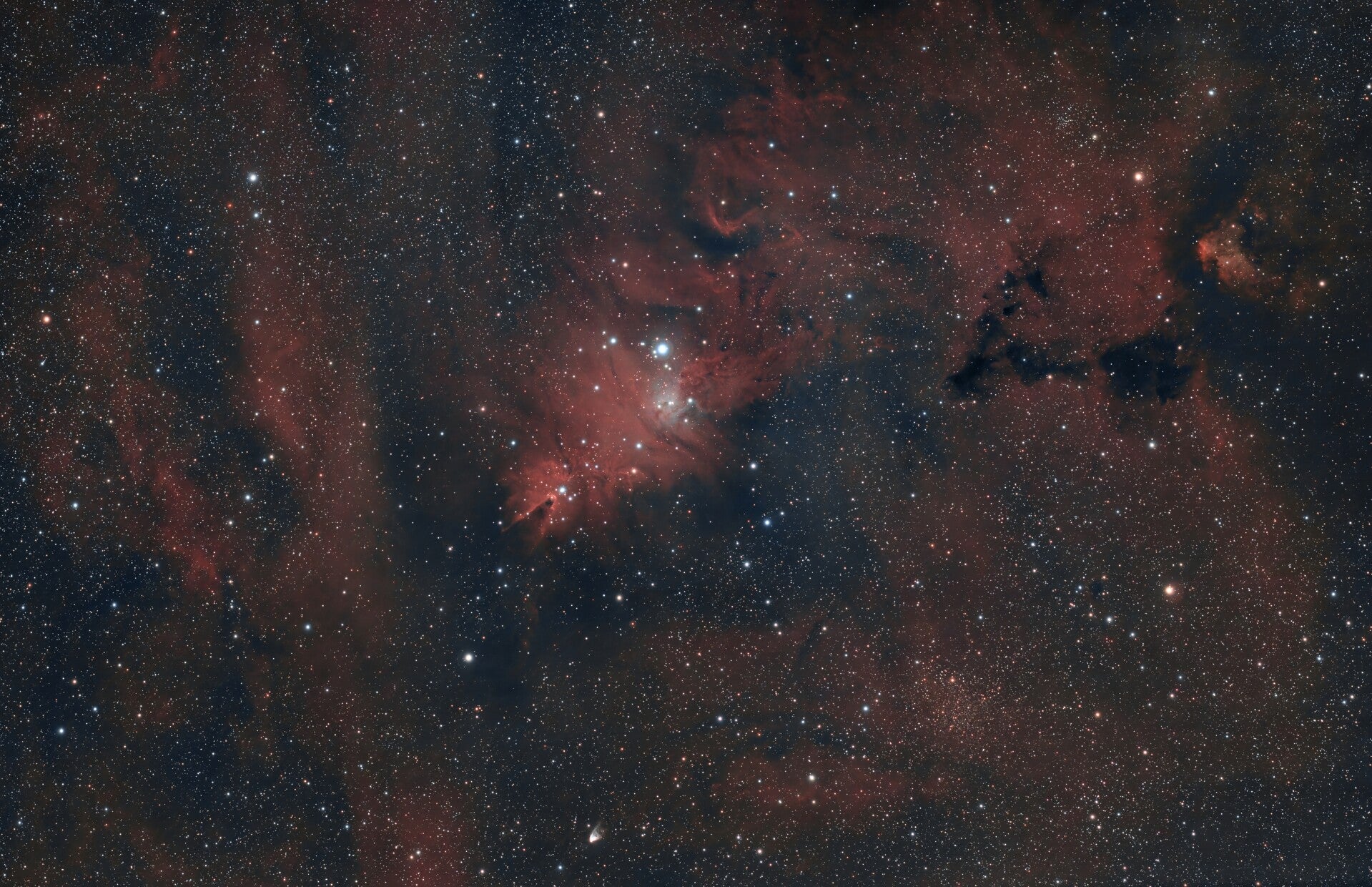
The Christmas Tree Cluster, Cone Nebula, Fox Fur Nebula, and Hubble's Variable Nebula
This image showcases a remarkable celestial tableau featuring the Christmas Tree Cluster, the Cone Nebula, the Fox Fur Nebula, and Hubble's Variable Nebula. The Christmas Tree Cluster (NGC 2264) is an open cluster of stars, so named because its brightest stars form a triangular shape reminiscent of a Christmas tree. Adjacent to this cluster lies the Cone Nebula, a dark molecular cloud that appears as a dark, conical pillar against the glowing emission nebula behind it. This region is a stellar nursery, where new stars are actively forming. Further within this expansive region of star formation, we find the Fox Fur Nebula (Sh2-273), a vibrant emission nebula whose intricate filaments of gas and dust give it its distinctive, furry appearance. Completing this cosmic portrait, and appearing like a comet at the bottom of the frame, is Hubble's Variable Nebula (NGC 2261). This fascinating object is a reflection nebula illuminated by the variable star R Monocerotis, which is embedded within it. The nebula's changing brightness and shape are directly linked to the activity of this central star, making it a dynamic and captivating subject for astronomers. Total exposure 5 hours with the FS-60CB, unguided 2 min subs on the EM-200 USD3
Create Your Own Website With Webador