Latest captures and cosmic chronicles

Welcome to my blog, where I share my latest astroimaging adventures and the stunning deep-sky objects I've captured under Cornwall skies. Journey with me through the cosmos, one image and story at a time.

Gazing into the deep sky

My passion lies in capturing deep-sky images of galaxies, nebulae, and star clusters. Each capture is a testament to the immense scale of the universe and a personal challenge to immortalise these celestial wonders under the beautiful yet often challenging Cornish skies. I hope these images ignite a sense of awe and wonder in you, just as they do in me.

The patience and pitfalls of astrophotography

Astrophotography demands immense patience, where every piece of equipment must align perfectly for a successful evening of data collection. The Cornish weather, with its unpredictable nature, often adds an extra layer of challenge. Fortunately, I've refined my setups for quick deployment, ensuring I can make the most of every clear moment. Follow along for tales of perseverance, technical triumphs, and the occasional humorous mishap.

Sharing the cosmic appreciation

Through this blog and my latest captures, I aim to share the profound beauty and endless mysteries of the cosmos. My greatest hope is that you, the viewer, will enjoy these images as much as I enjoyed capturing them, and that together, we can share a deeper appreciation for the wonders that lie beyond our planet.

Andromeda - the next project

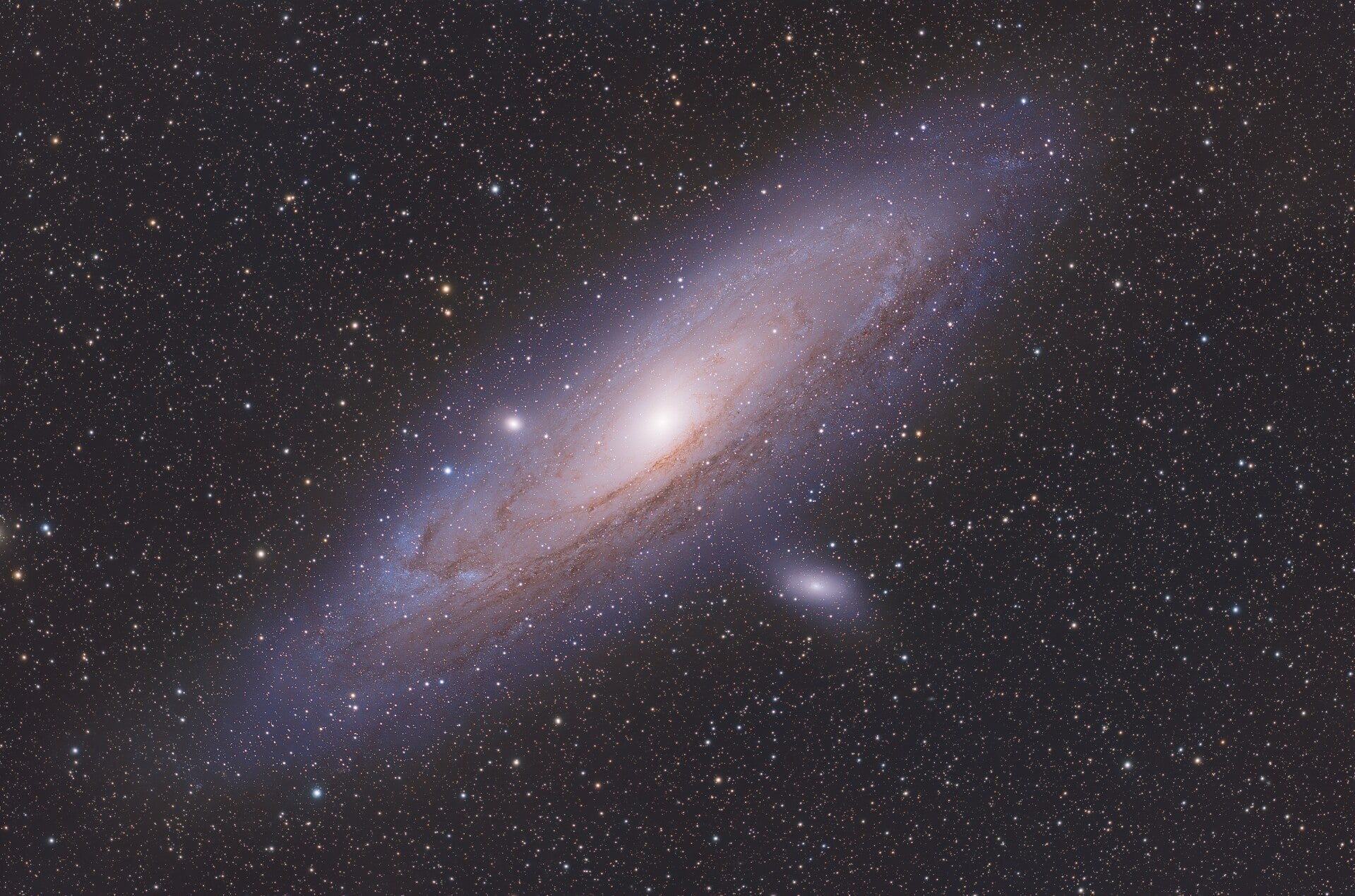
This monochrome image of the Andromeda Galaxy represents just one hour of data capture - 60x60 sec subframes with the Newtonian working at F3 with the Starizona Nexus focal reducer/field flattener. Whilst the spacing of the imaging train isn't perfect, Blur Xterminator in Pixinsight does a great job of repairing the stars in the corners. The SBIG camera still works great although it has to operate via its own USB2 Hub. The Starlight Xpress filterwheel and Pegasus Focuscube 3 operate off a separate USB3 Hub. To capture flat field frames for calibration I use a Pegasus Flatmaster panel which works perfectly in NINA. I use darks, flats and flat darks to calbrate the subframes prior to stacking. Hopefully some clear nights in the coming weeks will allow further imaging so I can add to the luminance channel then add some colour via the RGB filters before completing the project with some Hydrogen alpha data to bring out the star forming regions in the spiral arms. This scope is now incredibly fast at F3 and matches with the SBIG camera really well, even at shorter exposures.

Read more »

Solar Eclipse, Perseids and some Deep Sky Imaging

The Elephant Trunk Nebula, also known as IC 1396, is a striking region of star formation located in the constellation Cepheus. This nebula is particularly captivating when captured in the Hubble Palette, using a combination of Hydrogen Alpha, Oxygen III, and Sulphur II filters. With a total exposure time of 7 hours with the FS-102 and ASI 2600 MM Pro, the resulting SHO image reveals intricate details and vibrant colours, showcasing the nebula's dense clouds of gas and dust. The Elephant Trunk itself, a prominent feature within this nebula, is a dark silhouette against the glowing backdrop of newly forming stars. 

Read more »

CCD Astrophotography Setup

The Orion Newtonian telescope is fitted with my old SBIG ST-8300 CCD camera, and a Starlight Xpress filter wheel equipped with LRGB and H-alpha filters. Autofocus is achieved with the Pegasus Focuscube 3. It is mounted on the Takahashi EM-200 USD3 mount. As the mount does not have a functioning declination drive I can not autoguide, and at this longer focal length I am limited to 60 second subframes. The mount is powered by 2x12V batteries connected in series to give 24V which speeds up the RA drive which is helpful during the initial polar alignment routine with the QHY Polemaster. I locate the deep sky objects using the setting circles on the mount, then adjust the framing manually.

Read more »

Experimenting with the old SBIG CCD

In this session, I focused on testing the old SBIG ST-8300 CCD camera and RGB filters using the Newtonian. Each colour channel—red, green, and blue—was exposed for 20 minutes, with individual unguided subs lasting 60 seconds. I didn't use any calibration frames for this particular test. The target  was Messier 52, a star cluster in Cassiopeia , with the Bubble Nebula prominently positioned in the top left of the frame. This approach allowed me to assess the camera's performance and the effectiveness of the RGB filters without the additional complexity of calibration, providing valuable insights into the imaging capabilities of the setup. I was pleased with how this 16 year old camera performed, despite the fact that I've had to operate it via an older PC running Windows 10 Pro as Microsoft have blocked all the legacy drivers in Windows 11. Unfortunately the 2009 Starlight Express filter wheel is very glitchy so I'll be sending it for a software upgrade shortly. I do actually prefer the results from this CCD over the one-shot colour 071 MC Pro; the stars appear sharper. In addition the slightly smaller chip size means that stars appear less distorted at the edges and easily fixable in Pixinsight. 

Read more »

Latest Newtonian testing

Currently, I am still testing the backspacing and optimising the image train of the Newtonian. This is a portion of NGC 7000, specifically known as the Cygnus Wall. The image showcases just one hour of 60-second subs captured with the 071 MC Pro and L-Enhance filter. Although the exposure time is quite short, it demonstrates the potential of this  scope. 

Read more »

Recollimation of the Newtonian

This image of the Newtonian telescope illustrates the laser collimator used to realign the primary and secondary mirrors. Proper alignment is crucial for optimal performance, as even slight misalignments can significantly affect image quality. After using the laser collimator, a quick star test was conducted to assess the optics. The results showed that the mirrors were now better aligned, ensuring that the telescope is ready for the camera again. This process not only enhances the clarity of celestial images but also improves overall observational experiences.

Read more »

First Light with the Antlia Hydrogen Alpha filter

I recently conducted the initial test of the Antlia 4.5nm Hydrogen alpha filter, paired with the ASI 2600 MM Pro camera and the Takahashi FS-102 telescope. We are very pleased with the preliminary results. For this test, calibration was performed using dark frames only; proper flatfield acquisition is the next step to refine the imaging process. Hopefully I can add more data over the next few clear nights and incorporate Oxygen III and Sulphur II.

Read more »

Optimising and Testing the Newtonian

My 8 inch f4 Newtonian has recently been returned from Orion Optics UK after having the mirrors recoated and the optical elements aligned and collimated. I have added a Pegasus Focuscube 3 to the Baader Steeltrack focuser for more precise focusing at this fast F-ratio. It also allows for periodic refocussing through the imaging session as temperature changes. I have been struggling with optimised spacing and tilt and have been trying to model this through the Hocus Pocus plugin for NINA. Despite this I have managed a couple of images. Both were taken using 1 min unguided subs on the EM-200 USD3. Total exposure for each image 2 hours using the ASI 071 MC Pro camera and Optolong L-Enhance filter.

Read more »
