

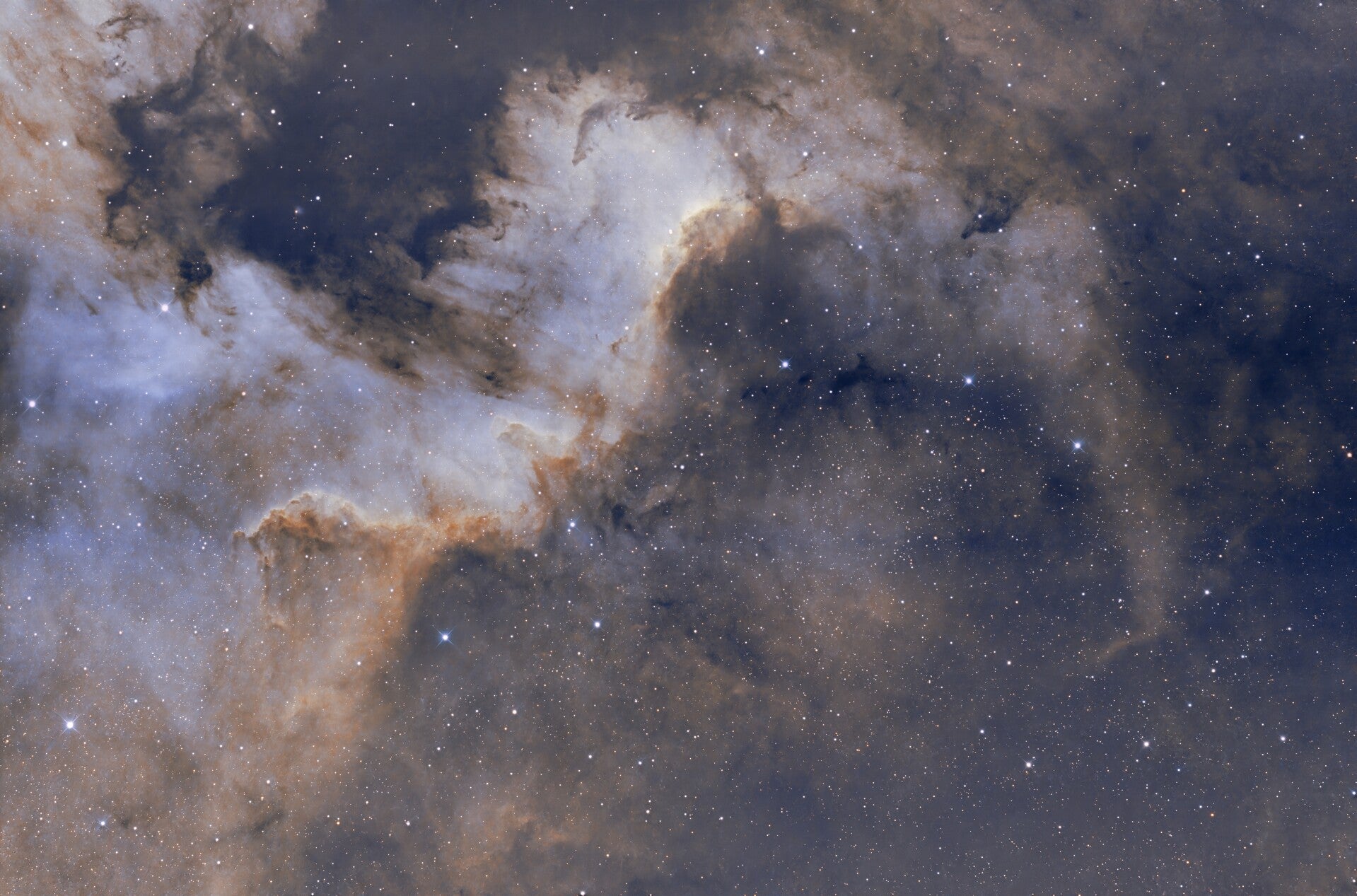
Exploring the Cygnus Wall: A Glimpse of NGC 7000
Currently, I am still testing the backspacing and optimising the image train of the Newtonian. This is a portion of NGC 7000, specifically known as the Cygnus Wall. The image showcases just one hour of 60-second subs captured with the 071 MC Pro and L-Enhance filter. Although the exposure time is quite short, it demonstrates the potential of this scope.
The Cygnus Wall is a feature located within the North America Nebula, designated as NGC 7000. This region is renowned for its intricate structures and vibrant colours, making it a favourite among astrophotographers and astronomers alike. When processed using the HOO (Hydrogen-Alpha, Oxygen III) palette in PixInsight, the Cygnus Wall reveals its breathtaking details, showcasing the rich textures and contrasts inherent in this deep sky object. The HOO palette enhances the emission nebula's features by mapping the Hydrogen-Alpha data to red and brown while the Oxygen III data is represented in shades of blue. This processing technique highlights the dynamic interplay of gases and dust, allowing viewers to appreciate the nebula's beauty in a new light. The North America Nebula, including the Cygnus Wall, is approximately 2,500 light-years away from Earth and spans about 50 light-years across. It is an active region of star formation, where new stars are born from the surrounding gas and dust, contributing to the nebula's ever-evolving landscape. Overall, the Cygnus Wall is not only a striking visual spectacle but also a significant site for studying the processes of star formation in our galaxy.
Add comment
Comments